


Jackson, Wyoming was not the only place in the West that experienced what was perhaps the weirdest winter ever. It wouldn’t matter if you have lived here only a few years or over 50 years, it was undoubtedly the weirdest due to the lack of snow in the valley and the unusually warm temperatures throughout the entire four winter months. To exemplify this winter, I will review Jackson’s weather data from December through March, and highlight all its uncommon stats.
Data presented for the Town of Jackson is from the Jackson Climate Station. Data for the mountains is from the Bridger-Teton National Forest Avalanche Center weather stations at the Jackson Hole Mountain Resort.
Jackson Town Temps
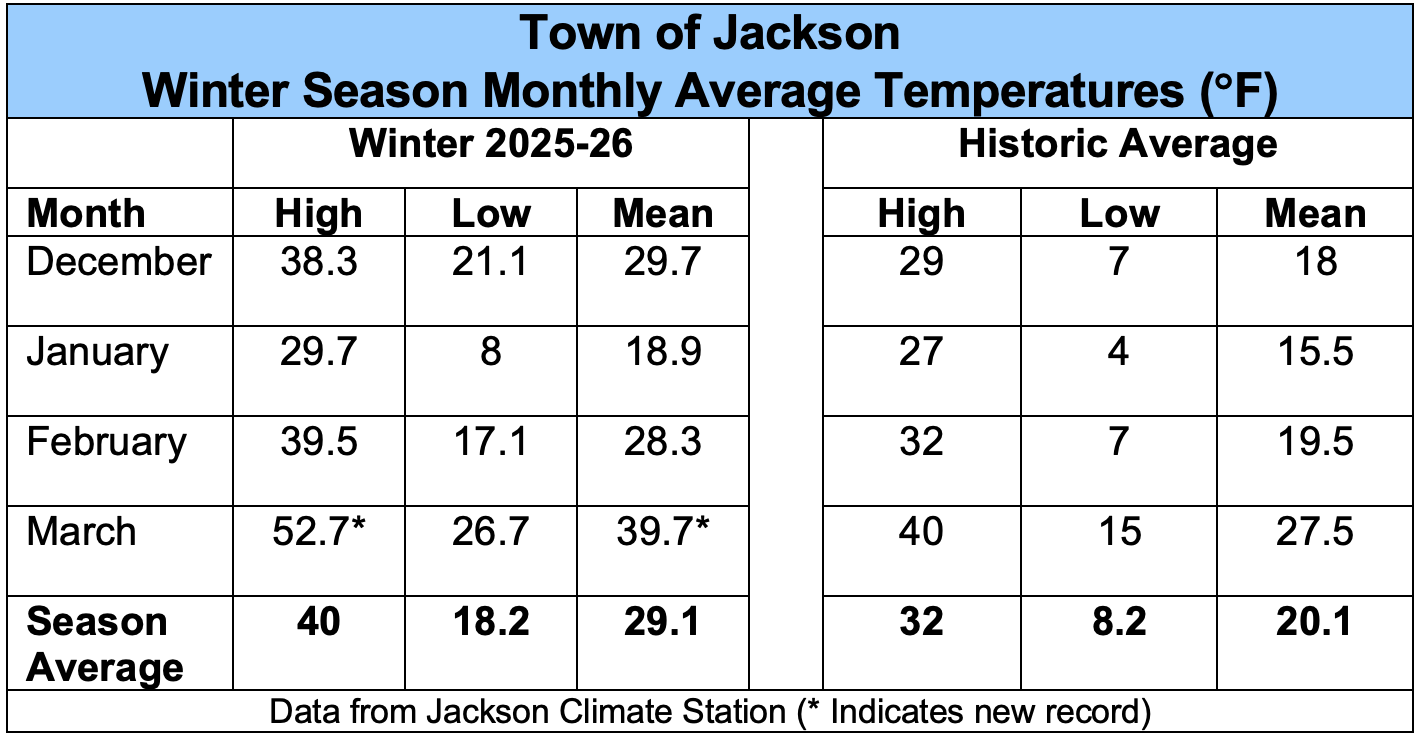
December was warm, but it was not the warmest ever in the Town pf Jackson. The average high temperature in December 2026 was 11 degrees warmer than normal, at 38.3 degrees. That fell short of the record set back in 1933 of 39.3 degrees. The average low temperature in December 2025 was 14 degrees warmer than normal at 21.1 degrees, which was not as warm as December of 1917’s average low of 25 degrees. The mean temperature in December 2025 was 29.7 degrees, again, not as warm as it was in 1917, with a mean temp of 31.1 degrees.
January 2026’s temperatures ran a little closer to normal, with the average high, average low, and mean temperatures all running just a few degrees above the long-term averages. This January’s monthly mean temperature was 18.9 degrees, whereas the warmest January on record was in 1953 with a mean temp for the month of 30.2 degrees.
You can read more about how the first half of winter played out in this blog post:
Unusual 1st Half of Winter 2025-26
Things didn’t get much better for the second half of winter. In February 2026 temperatures ran about 8 to 10 degrees warmer than normal but did not qualify as the warmest February on record. That record still belongs to 1947. The average high this February was 39.5 degrees, well short of the record 44.2 degrees from 1947. The average low in February 2026 was 17.1 degrees, also shy of the record of 20.1 degrees set in 1947. The mean temperature this February was 28 degrees, also well below the warmest February mean temperature on record of 32 degrees, from February 1947.
March was the real cooker though, and it deserves special acknowledgement.
March was more like April
March 2026 overall was about 10 to 12 degrees warmer than an average March, and it did break some maximum temperature records in town, but not by much. Starting with an average high temperature of 52.7 degrees in town this March, breaking the old record of 52.5 degrees from 1992, by just 2/10ths of a degree.
The average low temperature in March 2026 was 26.7 degrees, which was one-tenth of a degree cooler than the record warmest average minimum temperature of 26.8 degrees from March 2017.
The mean temperature for March 2026 was 39.7 degrees, beating the old record mean temperature from March of 1934 of 39.1 degrees, by six-tenths of a degree.
Relatively speaking, temperatures this past March were warmer than the average temperatures in Jackson for the month of April. The average high in April is 52 degrees, the average low is 24 degrees, and the mean temperature is 38 degrees.
On March 19th, 2026, Jackson hit 70 degrees, tying the record high for March of 70 degrees, set back on March 31st, 2004. On March 20th and 21st, 2026, the official town thermometer hit 71 degrees, establishing a new record high for the month of March.
The table below lists the monthly averages for Winter 2025-26 as compared to the historic averages.
Answering the question, “Was this the warmest winter on record in Jackson?”, is not as simple as you might think.
Looking at the temperature averages for all 4 months combined (December through March) I found too many winters that had incomplete data to support that assumption. In order to qualify, each winter month must have no more than 5 missing days of data. Prior to 2012-13, there were many winters which had 15 or more missing days. Some winters had entire months of data missing.
For example, in the Winter of 1933-34, December had the warmest maximum temperature on record, but too many low temperatures were missing to calculate a monthly mean temperature. During the winter of 1933-34 there were 45 total missing days of data in December through March, mostly low temperature readings in December and January, and there was no data at all for the entire month of February.
It would be safe to say that this December through March was the warmest in the last 14 years. Since 2012-13, all those winters had at most only 1 missing day of temperature readings.
Town Snow & Water
After three winters in a row with above average winter snowfall in the Town of Jackson, this is the first one that was below average, since 2021-22. Total Snowfall in town, for December 2025 through March 2026, was 45.4 inches. That is below the historic average for those four months of 62 inches.
What may surprise you is, this past winter did not have the least amount of snowfall ever in Jackson. December 2014 through March 2015 Jackson only had 43 inches of snowfall. Winter 2012-13 had 38.3 inches. The winter of 1976-77 only had 32 inches of snowfall. And two other winters checked in with a total snowfall less than this one, 1949-50 with 37.6 inches and 1946-47 with 35.6 inches.
What made this winter so bleak was, every time we got some snow in the valley, it either warmed up and melted, or it changed to rain and washed it all away.
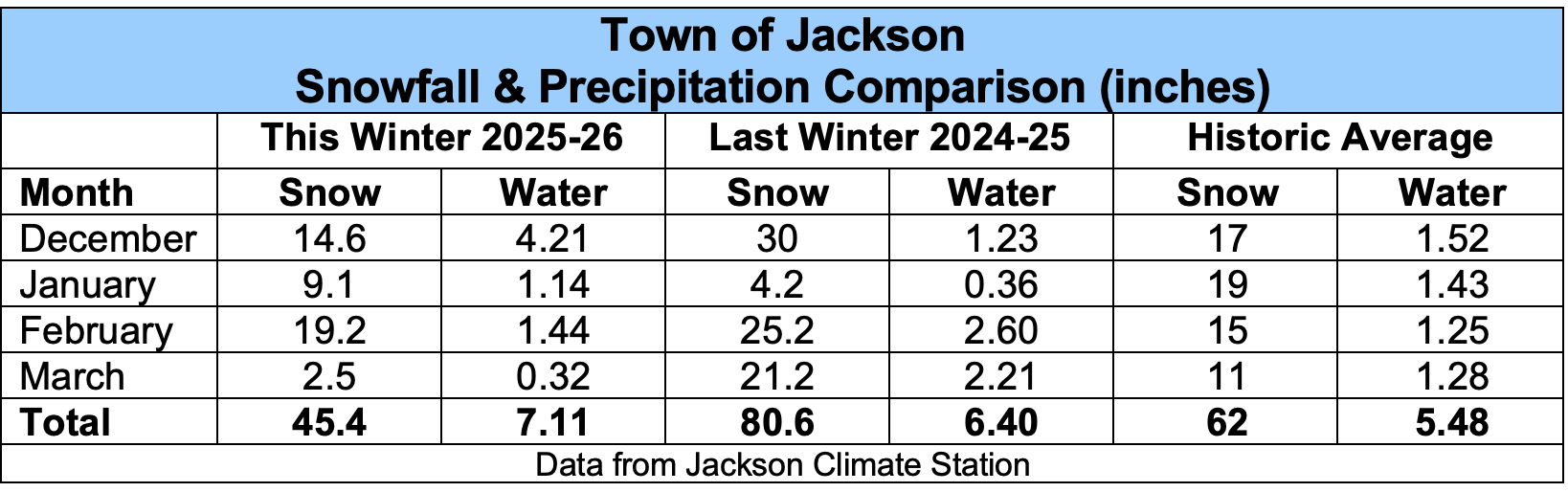
The good news coming out of this winter though is that Jackson had a wetter than average winter. With a total of 7.11 inches of precipitation in town for the four months, compared to a historic average of 5.48 inches. It was also wetter than the previous winter, which had a water total of 6.40 inches in 2024-25.
Mountain Snow
The total snowfall this winter at the Rendezvous Bowl weather station near the 9,600-ft. elevation at the Jackson Hole Mountain Resort, for December 2025 through March 2026, was 252 inches. That is 81 percent of the historic average of 311 inches.
Last winter, from December 2024 through March 2025, Rendezvous Bowl had 365 inches of snowfall. In 2023-24 it had 359 inches, and 2022-23 had 443 inches. Winter 2021-22 had 241 inches of total snowfall, which is less than we had this winter.
The settled snow depth at the Rendezvous Bowl station on April 1st, 2026, was 76 inches. The historic average on that date is 104 inches. On April 1st, 2025, it was 114 inches. On April 1st, 2024, it was 116 inches. On April 1st, 2023, it was 137 inches. And on April 1st, 2022, the snow depth was at 71 inches.
As far as the records: April 1, 1997 had the deepest snow depth of the last 50 years, with 156 inches. April 1st, 1977 had the least with 60 inches.
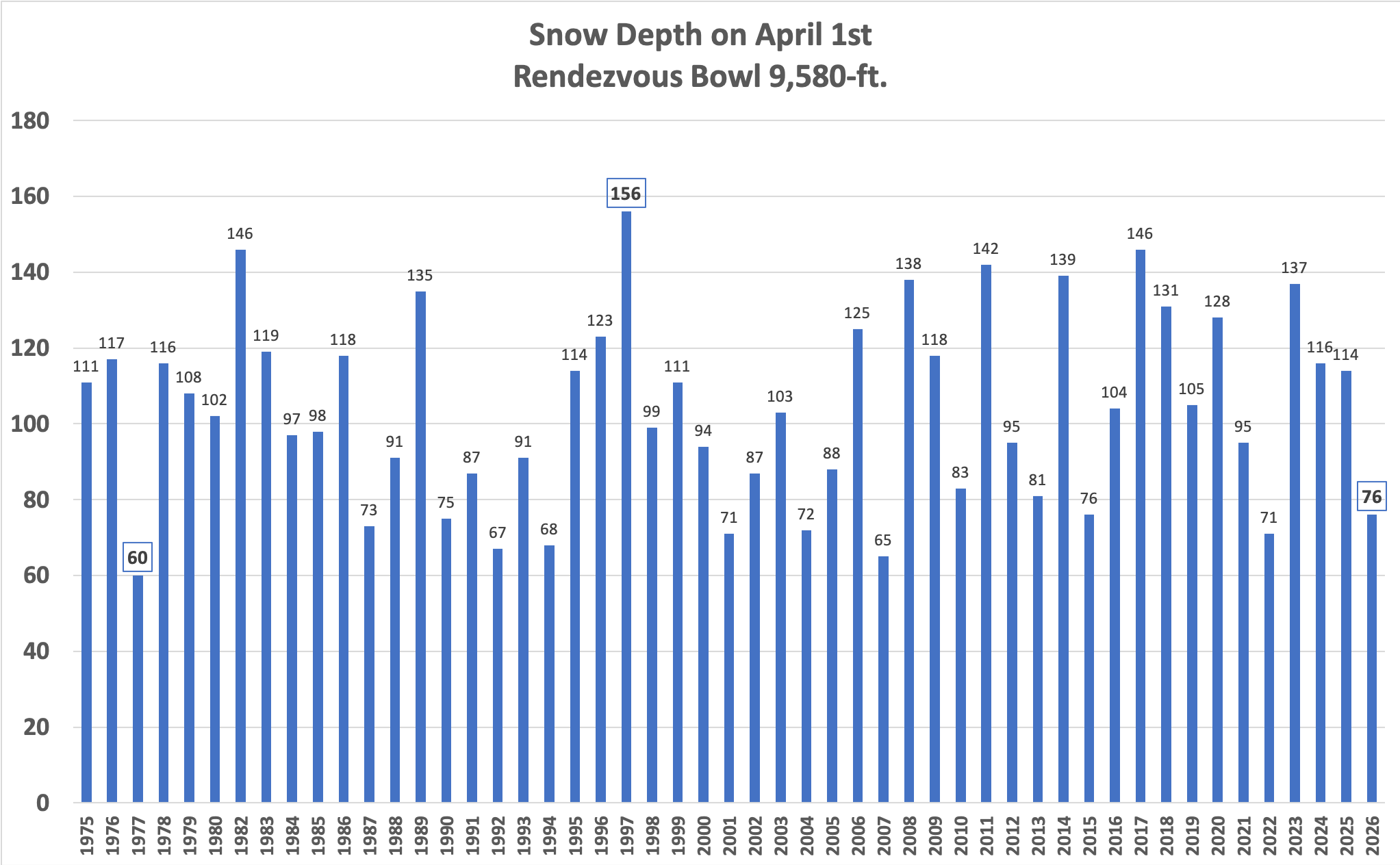
By the way, following a storm during the first couple days of April 2026 the settled snow depth in Rendezvous Bowl was back up to 93 inches on April 3rd, 2026.
After three seasons in a row with colder temps and above average winter snowfall around Jackson Hole, in both the mountains and the valley, I guess you could say maybe we were due for a below average year. Let’s just hope we don’t get three in a row like this one.
Post by meteorologist Jim Woodmencey